We usually experience life as a series of choices.
This or that.
Yes or no.
Stay or go.
From early on, we’re taught that we are decision-makers, constantly selecting from a menu of possible futures. It feels obvious. After all, we decide what to eat, where to live, who to be with, what path to take. Choice seems to sit at the very center of our sense of self.
But from time to time, I find myself wondering whether choice actually works the way we think it does.
We often imagine life as something like a movie with branching storylines. Each decision appears to open a new path, as if multiple fully formed futures are waiting for us just offscreen. Choose wisely, we tell ourselves, because everything depends on this moment.
Yet when I look closely at my own experience, life doesn’t quite feel like that.
It feels more like something unfolding.
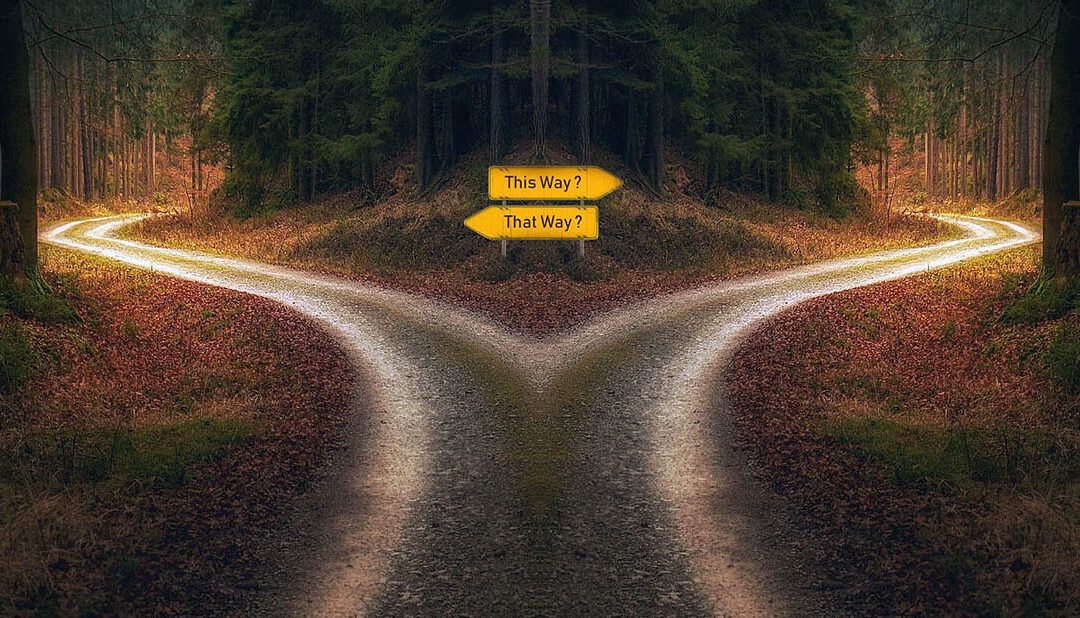
Take a simple moment: standing at a fork in a trail. The mind immediately goes to work. One path seems safer. The other more adventurous. Stories form instantly. What might happen here, what could go wrong there. It feels like two different lives are being weighed against each other.
But nothing actually exists yet except the moment itself. There are no hidden scenes waiting down either path. There is only the step that eventually happens.
The same thing shows up in more personal ways.
We might imagine entire futures with different people, careers, or cities. The mind is very good at building detailed stories about “what could have been.” But those futures never actually arrive. What arrives is always just this life, as it unfolds.
Even something as ordinary as ordering coffee or tea works this way. At the counter, it feels like two options are equally available. But once the order is spoken, only one reality exists. The other never lived anywhere except in thought.
This doesn’t mean we stop functioning or become passive. It doesn’t mean responsibility disappears. It simply suggests that what we call “choice” may be more like a narrative layered on top of action after the fact.
Looking back, we say, I chose this.
Looking forward, we say, I could choose differently.
But in the moment itself, something happens. And then the mind explains it.
Seen this way, life becomes less about constantly getting decisions right and more about paying attention to how things actually arise. Action still happens. Values still matter. Care still matters. But the mental strain of imagining and protecting dozens of alternate futures begins to loosen.
I’m not convinced this is something to believe or disbelieve. It’s something to notice.
When attention shifts from managing imagined paths to meeting what’s here, there’s often a surprising sense of ease. Less second-guessing. Less mental noise. More clarity in action.
Life still moves. Things still get done.
They just happen with less friction.
And that alone is worth exploring.
Summary:
This article challenges the common belief in personal choice, arguing that the mind creates the illusion of decision-making when, in reality, life unfolds moment by moment. It explores how choices—whether major life decisions or simple everyday selections—are not predetermined paths but simply actions that arise naturally. By seeing through the illusion of choice, we can align ourselves with a deeper awareness, allowing life to flow without the mental struggle of decision-making.
Main Points:
- The Illusion of Choice – The mind creates the perception that we are making decisions between fixed, pre-scripted life paths, but in reality, life unfolds moment by moment.
- Choice Exists Only in the Mind – Imagining alternative scenarios (e.g., different partners, different roads taken) is a mental construct, not reality. What happens is simply what happens.
- Living Beyond the Illusion – As awareness deepens, life’s actions arise naturally, not from deliberation but from an intuitive alignment with what is right.
Key Questions:
- Is decision-making an illusion?
- How does the mind create the perception of choice?
- Why do we believe in alternate possibilities that never actually happened?
- How can we live more freely by releasing the illusion of choice?
- What does it mean to act in alignment with awareness rather than perceived decisions?